

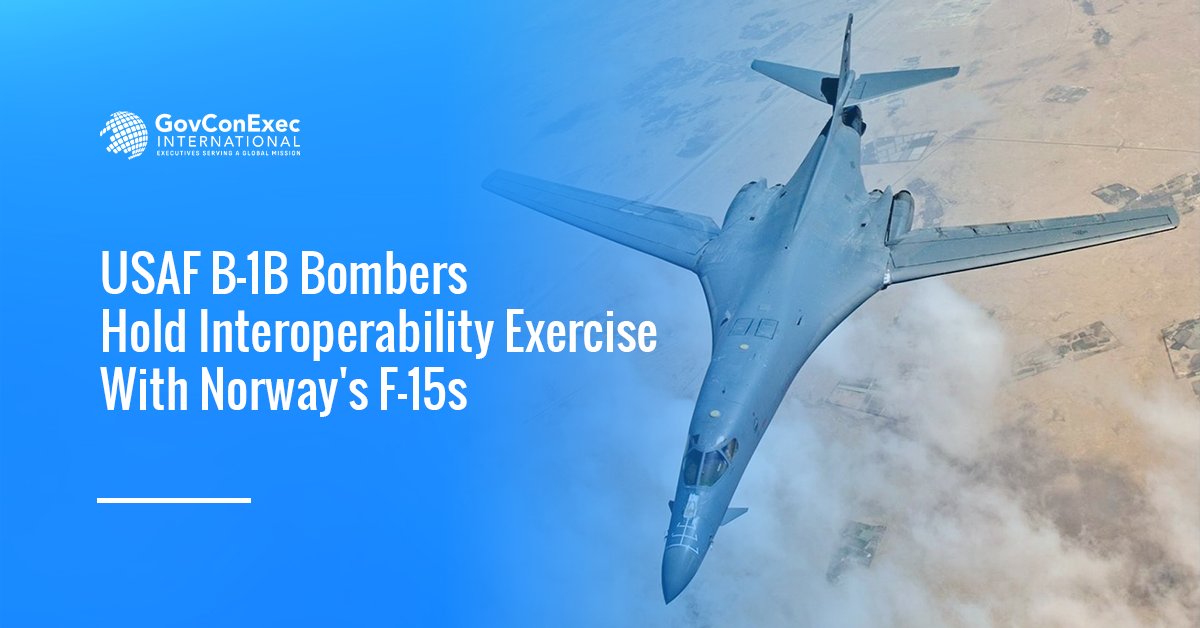
The U.S. Air Force and the Royal Norwegian Air Force conducted a recent joint training focused on interoperability for find, fix, target and track threats. The exercise in Ørland, Norway, involved three B-1B Lancer bombers from USAF’s 345th Expeditionary Bomb Squadron and F-35 aircraft from the Norwegian air force.
The U.S. Air Force Command said the participating aircraft’s F2T2 drill aims to sharpen allied capabilities to counter adversaries’ anti-access/area denial strategy.

Examine the geopolitical dynamics of partnerships reshaping the global defense sector at the Potomac Officers Club’s 2025 GovCon International Summit in Virginia on Oct. 16. Reserve your spot today.
Advantages of F2T2 Capability
The command says the joint F2T2 training enhances the survivability of U.S. and allied aircraft and improves their operational and targeting capability within complex, high-risk airspace.
Lt. Col. Eric Alvarez, commander of the 345th Bomb Squadron, stressed that they are training to be “resilient and postured” for modern warfare’s land-based or airborne challenges. “This training is vital not only for refining our skills, tactics and procedures but also for strengthening our relationships with allied partners,” he said.
The B-1Bs arrived in Norway on Aug. 9 from Dyess Air Force Base, Texas, partly manned by active-duty personnel and mainly by Reserve Airmen under the 489th Bomb Group.
The Lancer bombers’ Norwegian mission followed the BTF Europe deployment of two U.S. B-52H Stratofortress bombers at the Spartan Sword mission in Turkey for a joint exercise with Turkish F-16s in an inert weapons drop exercise.