
- Finland to help design and build next-gen USCG Arctic Security Cutters under ICE Pact
- Coordinated US-Finnish financing to back trusted AI, 5G/6G exports abroad
- Minerals framework seeks US investment in Finnish processing, refining capacity
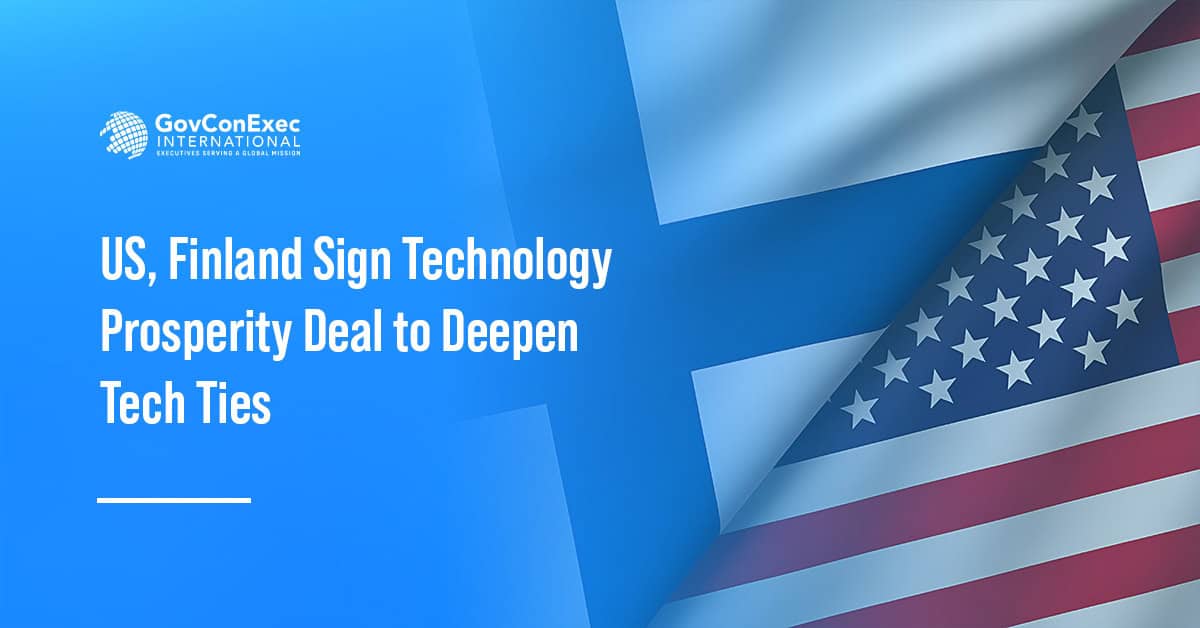
The United States and Finland have signed a Technology Prosperity Deal, or TPD, to deepen cooperation on emerging technologies, with plans spanning Arctic icebreakers, artificial intelligence, quantum and nuclear energy, according to a memorandum of understanding published by the White House.
Secretary of State Marco Rubio and Finnish Foreign Minister Elina Valtonen signed the nonbinding MOU, along with a separate Critical Minerals Framework, Thursday during a ceremony in the Treaty Room at the State Department in Washington, D.C. Speaking at the event, Rubio called the technology deal “an important milestone in our partnership on critical and emerging technologies.” Valtonen noted that bilateral trade in goods and services has grown by more than 60 percent in recent years, while U.S. direct investment in Finland has more than doubled.
“The TPD will further expand our long-standing cooperation,” said Sakari Puisto, Finland’s minister of economic affairs, in a Finnish government release. According to Puisto, collaboration with U.S. companies and research institutes is key to commercializing new technologies.
What Does the Deal Mean for US Icebreaker Modernization?
Under the Icebreaker Collaboration Effort, or ICE Pact, Washington plans to draw on Finnish expertise to help design, build and deliver the U.S. Coast Guard’s next-generation Arctic Security Cutters. The partners also intend to explore cooperation on ship design, shipyard management and workforce development. Beyond shipbuilding itself, they aim to co-invest in AI-driven manufacturing, ice technology, unmanned systems and space-based situational awareness.
Arctic connectivity is another focus. The two countries aim to support expanded satellite coverage at high latitudes and new subsea cables linking North America with Northern Europe and, eventually, the Indo-Pacific. A separate space workstream covers possible collaboration on future Artemis lunar surface missions.
What Are the Deal’s Goals for AI, 5G/6G & Quantum?
The TPD calls for joint promotion of trusted technology exports to third-country markets across the full AI and network stack, from hardware and models to network equipment and long-term customer support. Washington and Helsinki intend to back those exports with U.S. and Finnish financing and commercial diplomacy tools.
Standards are another priority. Both governments plan to coordinate positions at the International Telecommunication Union ahead of its 2026 Plenipotentiary Conference and the 2027 World Radiocommunication Conference, while working to move 5G and 6G research into commercial deployment faster.
For quantum, the deal envisions collaboration through national laboratories on algorithms and hybrid quantum-classical computing. The partners also aim to promote post-quantum cryptography standards and coordinate within NATO’s Transatlantic Quantum Community.
What Does the Critical Minerals Framework Cover?
According to the Finnish government, the companion framework is meant to make it easier for U.S. companies to invest in mineral processing and refining capacity in Finland. It is also designed to encourage joint corporate research and development on mineral recycling and new materials.
Rubio said critical minerals underpin semiconductors, batteries, defense systems and energy infrastructure, calling Finland an ideal partner given its depth in mining, refining and processing. For his part, Puisto said the partnership opens opportunities for Finnish mining and minerals companies.
What Other Areas Does the TPD Cover?
On energy, the agreement seeks to speed commercial deployment of American and Finnish reactors, including small modular reactors. Used nuclear fuel encapsulation, repository engineering, fusion and geothermal research are also included.
In biotechnology, the partners plan to use nationally governed health and research data to advance precision medicine and to strengthen biomanufacturing and health supply chains. Research security, meanwhile, applies across all workstreams, with plans for a bilateral dialogue on threats and entities of concern, tighter foreign funding disclosure rules for government-funded research and stronger investment screening.
How Will the MOU Be Implemented?
The MOU commits no funding, and either side can end it with 180 days’ notice. Implementation is set to run through a Joint Committee Meeting mechanism under the countries’ 1995 science and technology agreement, with intellectual property matters left to separate implementing arrangements.