

- The Pentagon currently operates more than 800 F-35s and plans to acquire 1,700 more through the mid-2040s, per a 2026 GAO report
- While the F-22 is faster, the F-35 is more versatile and carries a broader range of munitions
- Lockheed Martin said it has rolled out the final TR-3 software update to the F-35, but GAO warns that Block 4 modernization will not be completed until 2031
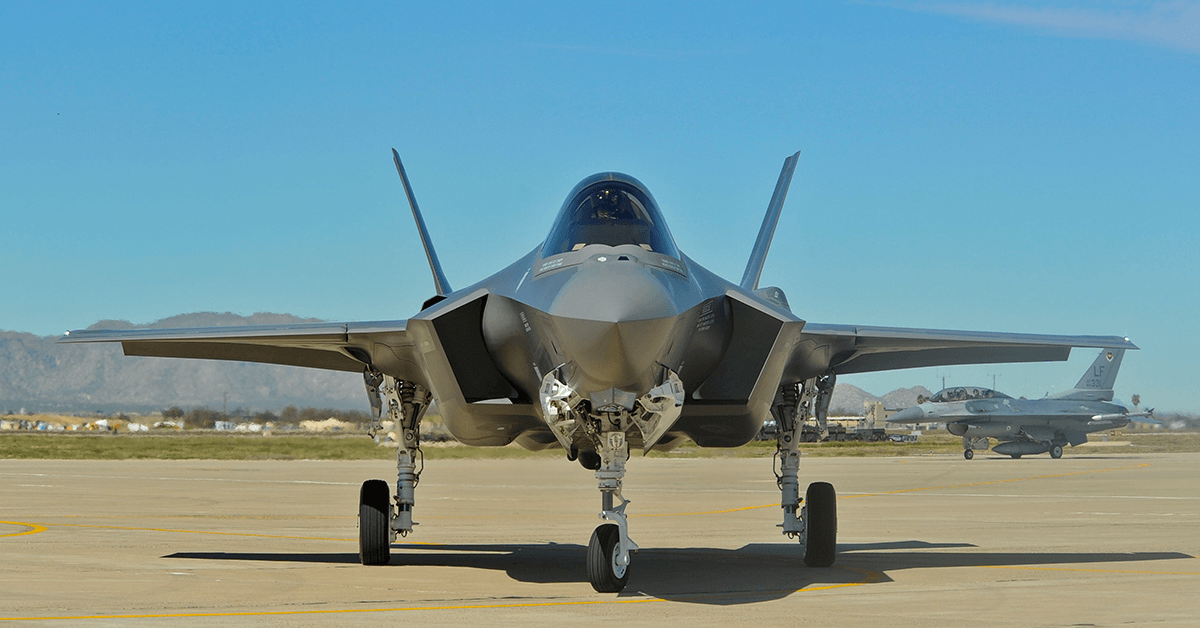
The F-35 Lightning II stands at the forefront of a new era in military aviation. Designed for stealth and situational awareness, the fifth-generation multi-role jet is slated to replace the U.S. Air Force’s aging fleet of fourth-generation fighter aircraft, the F-16 Fighting Falcon and the A-10 Thunderbolt II.
As part of the transition, the 35th Fighter Wing has confirmed the arrival of the F-35A Lightning II at Misawa Air Base in Japan, making it the first Pacific Air Forces installation in the Western Pacific to permanently host the next-generation aircraft, Aviation A2Z reported in June.
The Advanced Technology Behind the F-35 Lightning II
Designed to take the place of the country’s aging jet fighters, the F-35 series is built with next-generation technology. With enhanced stealth capabilities, this fighter jet aims to address the inadequacies and obsolete features of existing war air machines. These are coming from the inventories of the U.S. Air Force, the U.S. Navy and the Marine Corps.
The F-35 Lightning II delivers an unparalleled advantage for U.S. military pilots and global partners as it is the most advanced convergence in the 21st Century Security network vision. It is the National Defense Strategy in motion and stands as the cornerstone, not only of the U.S. Services Fighter Fleet, but also of allied fleets worldwide.
The F-35 Lightning II is an advanced technological weapon used by the U.S. military, including military contingents in several countries. Here, we provide you with its cutting-edge features and key characteristics to give you an idea of how efficient a fighting machine it is.
Key Features of the F-35 Lightning II
Takeoff and Landing
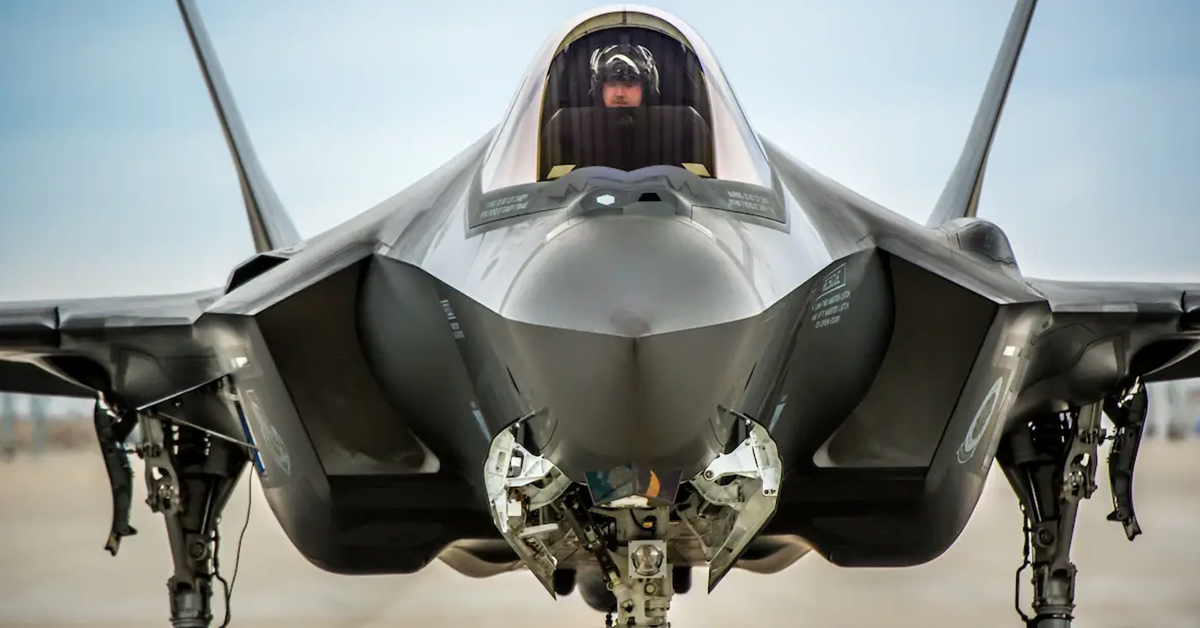
The F-35 is a single-seat, single-engine jet with three variants. The first variant, the F-35A, is a conventional take-off and landing, or CTOL, aircraft, while the F-35B is the aircraft-carrier type, or CV. The F-35C is the short-takeoff/vertical landing, or STOVL, variant. Other than that, they all have the same performance characteristics and advanced avionics.
Advanced Sensor Package
This feature collects, combines and distributes information more than any other fighter planes in history. It gives its operators a decisive edge over adversaries. At the same time, it has an open architecture, processing power, and information fusion.
Added to that, there are flexible communication links and sophisticated sensors. This makes it indispensable for homeland defense, major combat, and Joint/Coalition irregular warfare operations in the future.
Autonomic Logistics Information System
Aside from unmatched reliability plus maintainability, the F-35 comes with a support and training system that’s highly responsive. It has the latest information technology known as the Autonomic Logistics Information System, or ALIS.
The ALIS integrates the following:
- operational parameters
- current configuration
- current configuration
- component history
- scheduled upgrades and maintenance
- predictive diagnostics and health management
- training
- operations scheduling
- mission planning and aircraft service support
The ALIS integrated features help so much in the technological advancement of the aircraft.
Electro-Optical Distributed Aperture System
In essence, this feature provides pilots with situational awareness for advanced missile warning, using day and night pilot vision. It also has an Electro-Optical Targeting System, or EOTS.
The internally mounted system allows for extended-range detection. In addition, EOTS provides accurate targeting of ground targets and air-to-air threats.
Helmet-Mounted Display
All the intelligence and targeting information required to complete a mission is displayed on the helmet’s visor. Hence, there is no longer a need for the pilot to go over the dashboard to determine which switch to click for the next steps.
Advanced Tactical Data Links
Basically, this special feature allows for secure sharing of information among pilots in flight, as well as surface and ground platforms. This unmatched coalition interoperability could lead allied defense communities toward the migration of future net-centric fighting forces.
The F-35 Engine
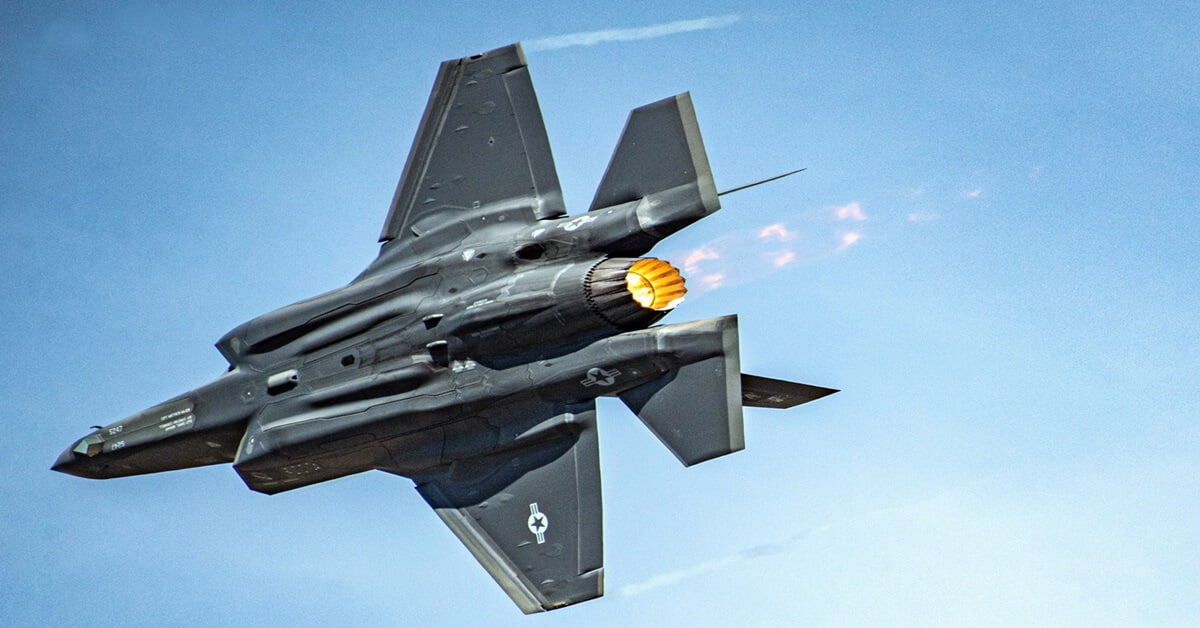
The engine can generate 43,000 lbs of thrust, powered by:
- six-stage compressor
- high-pressure single-stage turbine
- annular combustor
- three-stage fan
- low-pressure two-stage turbine
Mission System Integration
This feature provides F-35 pilots with positive target identification and precise all-weather strike capabilities. These and extraordinary over-the-nose visibility features dramatically enhance pilots’ performance.
General Characteristics of the F-35 Lightning II
Prime Contractor: Lockheed Martin
Function: Multirole fighter
Power Plant: One Pratt & Whitney F135-PW-100 turbofan engine
Tail Span (horizontal): 22.5 ft /6.86 m
Wingspan: 35 ft
Wing Area: 460 sq ft/42.7 sq m
Thrust: 43,000 lbs
Length: 51 ft (15.7 m)
Height: 14.4 ft (4.38 m)
Empty weight: 29,300 lbs
Takeoff Weight: maximum of 70,000 lb class
Fuel Capacity: Internal: 18,498 lbs
Payload: 18,000 lbs (8,160 kgs)
Speed: Mach 1.6 or 1,200 mph
Range: 1,350+ mi with internal fuel (1,200+ nm), unlimited with aerial refueling
Ceiling: Over 50,000 ft (15 kms)
Armament: Internal/external capability. Munitions vary depending on mission requirements (25 mm GAU-22/A; 2x AIM-120C; 2x GBU-31 JDAM)
Number of crew: 1
How Many F-35 Lightning II Planes Does the US Have?
According to a Government Accountability Office report published in June 2026, the Pentagon currently operates over 800 F-35 fighter jets and plans to acquire 1,700 more through the mid-2040s. The Air Force has also allocated $7.4 billion in its fiscal 2027 budget request for the purchase of 38 F-35s.
In a January press release, Lockheed said it has delivered 191 aircraft in 2025, exceeding its previous high of 142 jets in 2021. The company also shared that its annual production of F-35s is running at “a pace five times faster than any other allied fighter currently in production.
What’s the Difference Between the F-35 Lighting II and the F-22 Raptor?
The F-22 Raptor stealth fighter, despite being two decades old, is one of the most feared aircraft in the world. Manufactured by Lockheed Martin and Boeing, the aircraft is designed to provide stealth and maneuverability to project air dominance.
One key difference between the F-22 and the F-35 is speed. The F-22 is fast, capable of flying at Mach 2.2, whereas the F-35’s maximum speed is Mach 1.6.
According to National Interest, the F-22 excels in dogfighting. The aircraft is equipped with weapons designed for air-to-air engagements. In contrast, the F-35 is more versatile; it is designed to perform air-to-air and air-to-ground missions and electronic warfare activities.
The F-35 also carries different munitions, including nuclear weapons and anti-ship missiles.
Training and Simulation for F-35 pilots
On average, preparing pilots for the first time takes 192 hours of training. Almost half of the number of qualifying flights needed to become a pilot for this aircraft is conducted via a simulator. This is one unique training process in modern aviation. By using high-fidelity simulation, pilots can seamlessly transition from simulated trainer to jet.
The F-35 Full Mission Simulator is fully immersive and uses software just like the jet’s. It includes a sensor and a full weapons simulation. To make sure pilots are ready for future missions, they train for a wide range of simulated air-to-ground and air-to-air. Additionally, electronic warfare missions training is included.
What Happens at the End of F-35 Lightning II Training?
From Day 1 to the final flight, Lockheed Martin expert trainers work closely with pilots coming from all military services and countries that are part of the F-35 program. This is one way of ensuring all skills are mastered and every flight is safe.
After graduating from the F-35 training program, pilots are required to come back to the simulator for additional training to prepare for missions. Simulations reduce manual training costs and the wear and tear on the jets.
The F-35 has fifth-generation capabilities like stealth, sensor fusion, advanced sensors and networking. Thus, pilots are required to master new competencies every once in a while.
With simulation training, Lockheed Martin is redefining how pilots are educated on the range of expertise. This is critical in maximizing F-35 capabilities and to make sure flights are conducted safely at all times.
How Many Pilots Have Trained for the F-35 Lightning II?
The number of pilots trained to fly the aircraft is around 2,000 (or more), with 14,000 maintainers from 10 countries who have undergone training. These include graduate pilots and maintainers from the United States, the United Kingdom, Denmark, the Netherlands, Israel, Sweden, Norway, South Korea, Japan and Australia.
There are currently 24 training bases, with more to be established in 2025 to expand the pool of F-35 pilots and maintainers.
Future developments and upgrades for the F-35
Vehicle Management Computer
Additional computational power brought by the Vehicle Management Computer, or VMC, is being developed for the F-35 Joint Strike Fighter. The VMC will enable enhanced control modes to improve the efficiency and safety of the mission. This is part of the ongoing efforts to upgrade the jet’s platform within its service life.
BAE Systems’ quad-core next-generation processor for vehicle management was successfully tested during an F-35 Lightning II aircraft flight. Testing the VMC was done at Edwards Air Force Base and Naval Air Station Patuxent. It demonstrated an upgrade that was intended to maximize computer performance and address obsolete issues.
Partnering with F-35 program leader Lockheed Martin, BAE Systems provides the VMC, active inceptor control system, electronic warfare system, and aft fuselage for every F-35 found in manufacturing facilities in the US, the UK and Australia.
“The VMC provides the high integrity processing required to implement the advanced control algorithms that enable this platform’s critical missions,” stated Corin Beck, BAE Systems’ director of military aircraft systems for controls and avionics solutions.
Mr. Beck further highlighted that the said upgrade leverages BAE Systems’ technology’s path towards ensuring advancement of the jet’s mission management, including flight control capabilities not only today but into the future.”
Technology Refresh 3
Technology Refresh 3, also known as TR-3, introduces numerous upgrades to the F-35, including better displays, enhanced computer memory and processing powers, and hardware and software updates.
The F-35 conducted its first flight with the TR-3 upgrade in 2023. However, the Department of War’s F-35 Joint Program Office paused deliveries of the F-35 in recent years due to delays related to the TR-3.
A Lockheed executive said in June 2025 that the company has delivered the last software updates to the F-35, noting that the TR-3 has “reached that point” where it is stable enough to accommodate new combat capabilities, Breaking Defense reported. The TR-3 is expected to provide the computational horsepower needed for the planned F-35 Block 4 upgrade.
Block 4
Block 4 will modernize the F-35 by integrating new warfighting technologies, including a new suite of sensors, precision weapons with longer range, enhanced EW features, cross-platform interoperability and data fusion capabilities.
A September 2025 report by GAO estimated that the Block 4 modernization will not be complete until 2031, two years later than its previous projections. GAO also warned that Block 4, under a subprogram established due to a congressional mandate to accelerate the effort, will have “fewer capabilities.”
At the Paris Air Show in 2025, Lockheed said Block 4 is the “most aggressive upgrade in any fighter in history.”
“We must bring Block 4 in, because we know that the threat continues to evolve, and we have to stay ahead of it,” J.R. McDonald, Lockheed’s vice president of business development for the F-35 program, stated per National Defense.
“Number one, all of the sensors [are] being improved dramatically. Number two, the ability to carry more and different types of weapons,” he added. “And number three, and I think this will become the ultimate game-changer, is the additional interoperability features that will allow us to communicate across the domains and be that central node in the battlespace.”