
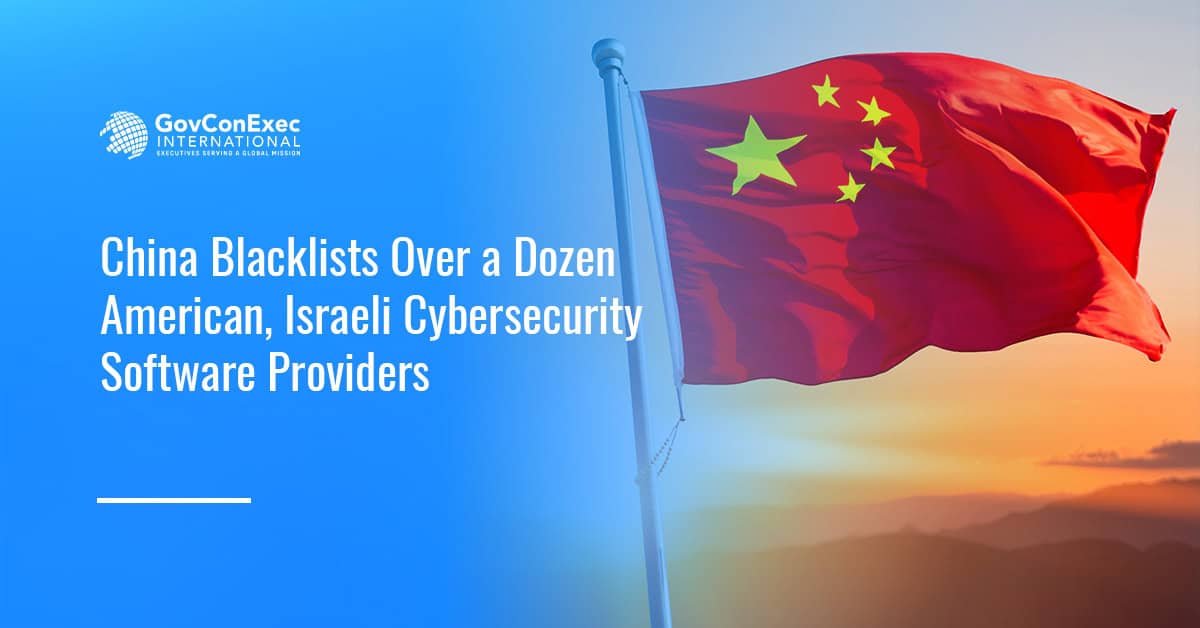
The Chinese government has barred domestic companies from using American- and Israeli-made cybersecurity software, citing national security concerns, people familiar with the matter told Reuters.
In a report published Thursday, the American companies covered by the ban are VMware, Palo Alto Networks, Alphabet-owned Mandiant and Wiz, CrowdStrike, SentinelOne, Recorded Future, McAfee, Claroty and Rapid7. The Israeli firms included in the list are Check Point Software Technologies, Orca Security, Cato Networks, CyberArk and Imperva.
CyberArk was acquired by Palo Alto in 2025, while Thales purchased Imperva in 2023.

Cyber as the primary attack surface for international conflict is one of the key issues to be discussed at the Potomac Officers Club’s 2026 Cyber Summit on May 21. The critical GovCon conference will bring together government and industry experts to explore the increasing cyberthreats American systems are facing and provide updates on cybersecurity initiatives across agencies. Secure your tickets today.
How Will the Chinese Ban Impact American Cyber Companies?
In a statement, CrowdStrike said it is “only be negligibly affected” by the ban because it does not sell to nor operate offices in China. SentinelOne commented that it has “no direct revenue exposure to China,” while Recorded Future and Claroty shared that they do not do business or sell in China.
Orca Security CEO Gil Geron revealed to Reuters that his company has not been notified that it has been blacklisted in China, but added that a ban is “a step in the wrong direction.”
When Will Trump Visit China?
President Donald Trump is set to meet with Chinese President XI Jinping for a state visit to Beijing in April.
Following a phone call between the two leaders, Trump wrote on the social media site Truth Social that the United States’ relationship with China is “extremely strong.”
In a statement, China’s state news agency added that the countries should “keep up the momentum, keep moving forward in the right direction on the basis of equality, respect and mutual benefit.”
Trump and Xi previously agreed to ease tariffs and suspend export controls, especially on rare earth elements, after a meeting at the Asia-Pacific Economic Cooperation, or APEC, summit in October.
The U.S. also recently authorized Taiwan Semiconductor Manufacturing Corp. to import American chipmaking equipment to its facility in China.